

It’s no secret that your search engine ranking depends primarily on the amount and quality of links you get to your website/blog.
While it’s very true, there are certain on-page search engine ranking factors that will definitely serve you right to pay attention to.
Some factors scream, some whisper and the opinions vary as far as which are which.
My suggestion: don’t get into debates and just implement all of them.
1. Domain name (age and keyword relevance).
I want to make sure you understand EXACTLY how important domain name is.
If you have 2 websites with all the other factors being equal, the e with the right keywords in the domain will rank higher.
Look at this example:

Insurancequotes.com rates #1 for “insurance quotes”, even before such insurance behemoths as AllState, Geico, Progressive, to name a few, simply because they have exact keyword phrase as their domain name.
It’s that powerful.
2. Title tag

Do you see where it says “Internal Deep Linking Revealed | Traffic Generation Cafe” at the very top?
That’s my title for this particular page and it starts with my keyword - extremely important.
It also has no unnecessary words like “AND”, etc; it uses “|” character to separate 2 keyword phrases (not super important, but helpful); it’s short and concise.
Here’s an example of not-so-great title tag (Carla is working on it per my suggestion):

I know it’s a bit hard to see because it’s soooo long. Don’t do that way!
See how many keywords she mentions there? Will she rank for any of them? Not a chance.
Where do you change your title tag?
If you are using Thesis theme, like I do, then it’s very simple: all your SEO options are taken care of under “SEO options” section under your post in editing mode.
If you don’t have Thesis yet (and why don’t you, may I ask?), your best option is to use All-in-one-seo-pack plugin.

3. Page Name (yoursite.com/pagename.html)
Make sure you use your keywords in your permalinks - the “pagename.html” part. To learn more about permalinks and get some more SEO tips, visit my High Search Engine Ranking Optimization Tips.
4. Headline tags H1, H2, H3.
“H” stands for “headline” and the following numbers indicate how important the headline is, 1 being the most important one.
Make sure your headline tags include your main keywords without spamming them, of course.
5. First sentence and last sentence.
Google pays particular attention to those, so once again, make sure your main keywords are present in those sentences.
6. Keyword Density (2-8% is normal).
Some SEOs pay attention to this aspect, some say it’s not important.
Here’s my take on it: if you right a post around a particular keyword and don’t think too much about it while writing the post, your keyword density will be perfect. It certainly won’t hurt to get this one right.
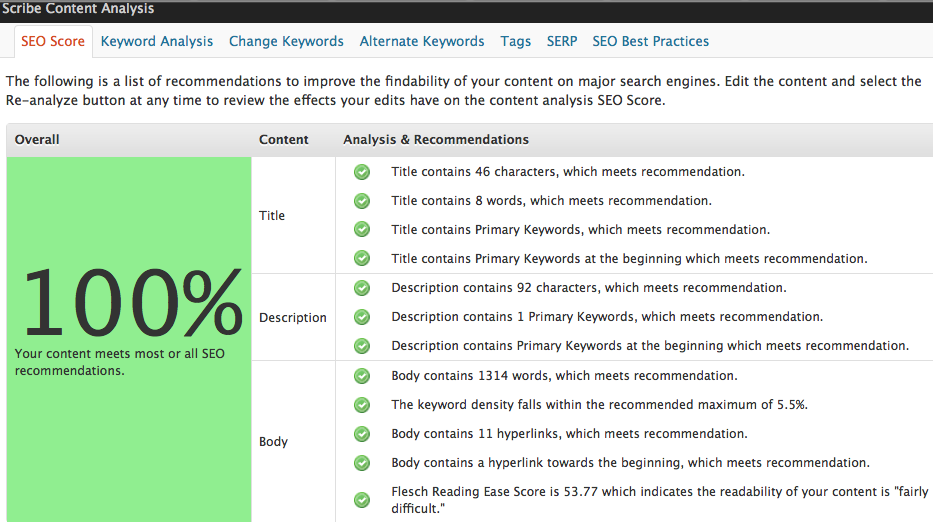
Or even better, do what I do - use Scribe SEO plugin to do all this and much more automatically. I tell you, I can’t live with myself until I achieve a perfect score on each post I write. 🙂
Here’s what it looks like:
7. Page Load Time:
Google punishes slow, and milliseconds are slow to Google.
You can do some very simple changes to your blog to maximize your loading time:
- Get rid of unnecessary plugins and stop uploading even more of them.
- Keep your image files small.
- Install WP Super Cache plugin - ignore what I just said above and definitely get it.
8. Content Length:
Keep your posts at 500 - 1000 words.
Too few words don’t give Google enough information to know what the content is about. Wordy posts affect conversion.
9. Image Names and Alt Tags.
One of the easiest things to forget indeed.
When you insert an image into your post, you’ll see a box like this one:
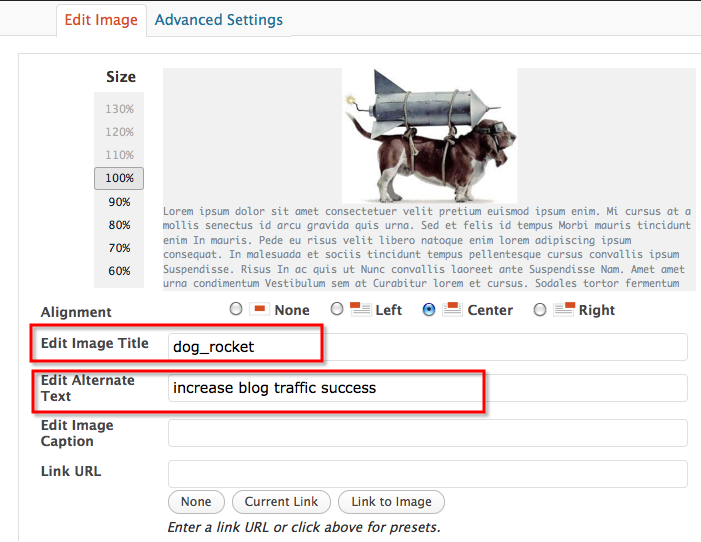
Relevant images need a relevant name (although I must admit the name of the image above sucks - don’t do what I did there, do what I say to do:) and alternative text, which is your alt tag.
Non-relevant images should receive a number and no alt tag (by no alt tag I mean just leave it empty).
10. Bold and italics.
Show emphasis, although are not too important.
This factor definitely whispers.
Of course, there is much more to both on and off-page optimization then this - we both know it.

Hi Ana,
Really enjoyed this article and totally agree with all the tips.
A little keyword research and persistence can give you great results.
Be sure to know what your site’s focus is and it makes getting Search Engine Traffic easier
Thank you for your contribution,
Jeff Faldalen
For someone looking to to tackle their own marketing and page ranks, this is a great go-to. It’s amazing what you can do by marketing yourself with little tricks; there’s a fine line between TOO much and TOO little. Though, it’s hard to compete against big companies with basic keywords. When looking to choose them for your own site, aside from registering the domain in it, what’s the best way to go about it?
Hi Maggie,
Great question. I have found the big sites focusing more on branding then SEO. It is easy to compete for word that are not as competitive and commonly used. A little keyword research goes a long ways.
As Ana mentioned, always put your keyword in the title of the post
Hope this helps,
Jeff
Thanks for getting back with Maggie, Jeff - can’t believe I missed her question.
Is increasing page download speed really important? Some residential real estate sites that I was worked provided a great test bed. They were huge sites, in the 50,000 to 100,000 page range. We made some changes that increased download speed by 35%. The result was about a 20% increase in search engine traffic to the sites we optimized.
Grant says
Hi I have installed commentLuv on my blog and have noticed an increase in good quality comments. Does this help my google ranking or is it just a very good way of building a backlinking community? Grnat
Great question, Grant, - and a very debatable one, I might add. 🙂
In my humble opinion, absolutely.
Not necessarily because of backlinks (CommentLuv actually leaks your pagerank if anything else).
Google has recently started to pay special attention to sites with visible visitor engagement. The more comments, clicks, traffic you get, the more favorable your site looks in Google’s eyes. You look more legitimate.
Plus, more comments create the social proof you need to gain more customers.
If somebody comes to a busy blog with lots of comments, the new visitor sees value in it and is more ready to buy.
Makes sense? I hope so.
Thanks for the great question.
Ana